Wednesday, June 20, 2018

Thursday, March 8, 2018
The Book of Questions - A Catalyst for Interaction
The article I chose to read was titled Socialization Groups: Using The Book of Questions as a Catalyst for Interaction. What about this article that caught my eye was the fact that they were using a book solely of questions as a means of an assessment. As an OT student, when I think of assessments, I automatically think of the standard one's used across the board. This gave me an insight on how we, as OT's, can turn nothing into a valuable something, such as this book.
The Book of Questions, in an assessment means, is basically a self-report questionnaire and interview between oneself and other group members. This "interview" allows the therapist to collect a dynamic assessment of that individual. The book also works as a social activity, in which the clients get to simulate verbal interaction between others. This allows the therapist to get a view of that client's ability to socially and interpersonally interact. Many other valuable information can be collected from this "assessment" such as: the ability to imagine, their use of concrete and abstract thinking, their line of defense and coping mechanisms. From a group facilitation standpoint, this assessment has high levels of effectiveness at the Montefiore Medical Center. After only 8 months of switching to this inception of the group, it has been identified as the most successful group in the occupational therapy program at this specific inpatient facility.
I wish I had found and read this article before administering my individual group facilitation because it might have changed my mind on what topic I would facilitate over. I just loved how much insight this simple activity gave the therapist. Whether it be revealing a client's personal experience, to hypothetical reasoning, to personality characteristics, or to their interpersonal view of themselves, it gave the therapist a well rounded assessment and evaluation of those specific clients. I think the best part about it though was the want and access to this book after client's have been discharged. The book's purpose wasn't just meant for mental health patients, but for anyone seeking an opportunity to become socially interactive. It has the power to build old relationships and develop new ones sampling by purchasing the book and starting a conversation with someone by asking the questions written right in front of you.
As a student, I would have loved to see this book in action. It seems to be a great investment and I think future students would benefit from it during the Groups course.
article.aspx
Wade, J.C. (June 1992). Socialization groups: Using the book of questions as a catalyst for interaction. American Journal of Occupational Therapy. 46(6), 541-545. doi:10.5014/ajot.46.6.541
The Book of Questions, in an assessment means, is basically a self-report questionnaire and interview between oneself and other group members. This "interview" allows the therapist to collect a dynamic assessment of that individual. The book also works as a social activity, in which the clients get to simulate verbal interaction between others. This allows the therapist to get a view of that client's ability to socially and interpersonally interact. Many other valuable information can be collected from this "assessment" such as: the ability to imagine, their use of concrete and abstract thinking, their line of defense and coping mechanisms. From a group facilitation standpoint, this assessment has high levels of effectiveness at the Montefiore Medical Center. After only 8 months of switching to this inception of the group, it has been identified as the most successful group in the occupational therapy program at this specific inpatient facility.
I wish I had found and read this article before administering my individual group facilitation because it might have changed my mind on what topic I would facilitate over. I just loved how much insight this simple activity gave the therapist. Whether it be revealing a client's personal experience, to hypothetical reasoning, to personality characteristics, or to their interpersonal view of themselves, it gave the therapist a well rounded assessment and evaluation of those specific clients. I think the best part about it though was the want and access to this book after client's have been discharged. The book's purpose wasn't just meant for mental health patients, but for anyone seeking an opportunity to become socially interactive. It has the power to build old relationships and develop new ones sampling by purchasing the book and starting a conversation with someone by asking the questions written right in front of you.
As a student, I would have loved to see this book in action. It seems to be a great investment and I think future students would benefit from it during the Groups course.
article.aspx
Wade, J.C. (June 1992). Socialization groups: Using the book of questions as a catalyst for interaction. American Journal of Occupational Therapy. 46(6), 541-545. doi:10.5014/ajot.46.6.541
12- Step Meeting
I, as a student, attended a alcoholics anonymous 12-step meeting on Sunday March 4, 2018. The group "leader" acted as a facilitator. I think this was done to keep the mood light and make it less difficult for the group members to share their thoughts and opinions. He shared that we was also an alcoholic himself from years past, which seemed to relax the newcomers. In my opinion, this was probably shared so the group members knew their "leader" could relate to them.
At the beginning, the facilitator reiterated that sharing wasn't required but encouraged throughout the entire meeting. Some discussions were open to all to speak in random orders, and other discussions were passed around the circle in a certain order. If someone hadn't said anything in a while, he would directly ask them if they had any thoughts about a certain topic. I say the majority of the group participated at all times, even if minimally, so there wasn't many needs to call certain people out.
The meeting I attended was at a church downtown. For some, I feel as if they felt intimidated for just being in a church rather than an AA meeting. This was never shared, just my observation. It was small (around 8 people) and intimate. They sat in a circle and I was listening a little ways away. I think sitting them in a circle had a huge impact on the amount of people sharing, as if they felt a closer connection to the people around them.
From the short amount of time I was there, I found this group to be extremely client-centered. The facilitator often stepped back and didn't speak unless it was absolutely necessary, such as the beginning of a new topic. He also stayed seated the whole time, as if he was letting them know that he was not superior but equal. It was also really interactive and followed what the members wanted to talk about / work on rather than what the facilitator felt was necessary for the group.
I definitely believe that the session was therapeutic for some, and for others not so much. As an observation, you could tell who really cared about being sober and who was there because they needed to be legally. You could also tell who had been attending longer than others based on friendships formed in the group and statements such as "as some of you know" and etc. No matter their AA background, they all seemed to get a long with the facilitator, in which is an important factor to building therapeutic relationships and rapport.
At the beginning, the facilitator reiterated that sharing wasn't required but encouraged throughout the entire meeting. Some discussions were open to all to speak in random orders, and other discussions were passed around the circle in a certain order. If someone hadn't said anything in a while, he would directly ask them if they had any thoughts about a certain topic. I say the majority of the group participated at all times, even if minimally, so there wasn't many needs to call certain people out.
The meeting I attended was at a church downtown. For some, I feel as if they felt intimidated for just being in a church rather than an AA meeting. This was never shared, just my observation. It was small (around 8 people) and intimate. They sat in a circle and I was listening a little ways away. I think sitting them in a circle had a huge impact on the amount of people sharing, as if they felt a closer connection to the people around them.
From the short amount of time I was there, I found this group to be extremely client-centered. The facilitator often stepped back and didn't speak unless it was absolutely necessary, such as the beginning of a new topic. He also stayed seated the whole time, as if he was letting them know that he was not superior but equal. It was also really interactive and followed what the members wanted to talk about / work on rather than what the facilitator felt was necessary for the group.
I definitely believe that the session was therapeutic for some, and for others not so much. As an observation, you could tell who really cared about being sober and who was there because they needed to be legally. You could also tell who had been attending longer than others based on friendships formed in the group and statements such as "as some of you know" and etc. No matter their AA background, they all seemed to get a long with the facilitator, in which is an important factor to building therapeutic relationships and rapport.
Wednesday, February 21, 2018
Individual Facilitation - Let's Talk Shopping!
Yesterday, I facilitated a group over the life-skill of "shopping". While I am an avid shopper myself, I chose this topic to help others (and myself) that shopping entails way more than just a trip to the mall or grocery store. The aim and purpose of my session was to give my group members and idea of how different shopping can be depending on the person, their particular task, their context, and their performance ability. Most people, such as everyone in my group, don't think of shopping as a complex task. But in fact it is; it includes preparing a list, selecting, purchasing, transporting, and paying for your item(s). For those who do lead group sessions one day as an OT, I wanted to give them an idea of something fun and realistic they could do for those who consider 'shopping' as one of their meaningful activities.
For a warm-up activity, I had them all choose an item or items that they were currently on the look for. We had a wide variety of answers such as: a house, a dog, a plane ticket. I had them create an activity analysis... or a list of important steps they need to take to purchase these items. For the main activity, I created a board game where the members rolled the dice and then read and answered the corresponding question on the board. All the questions were shopping related and open-ended, whether it be about money or purchasing habits. The person to the player's right also got to answer the question, give them feedback, or say why they disagreed with that particular player. I think this was the best part of the activity. Each member was open to what the other one had to say and really honed into their personal feelings about a shopping related question.
I was nervous at first, but I have to say that my facilitation was a success. This is because at the end, the group members were asked if they would like to change or manipulate their original activity analysis in any way. A majority of the members did because they took to heart what others had to say. For example, one group member said she usually shops alone but would take someone with her the next time so she can have some positive feedback from a friend in the dressing room. They also got useful money saving tips from each other, such as budgeting or coupon apps.
I'm going to be honest and say that I wasn't looking forward to this group facilitation. It was right after a difficult EBP test, we had already been in class for 8 hours, and I was definitely lacking in the sleep department. But after it was over, I had some relief because it had gone well and Professor Sasse had provided me with some useful feedback. I also was nervous about the "pop question" at the end, but realized that I do have an OT brain and I am able to think on my feet when needed. This was good practice for future OT implication, even out of the groups course.
For a warm-up activity, I had them all choose an item or items that they were currently on the look for. We had a wide variety of answers such as: a house, a dog, a plane ticket. I had them create an activity analysis... or a list of important steps they need to take to purchase these items. For the main activity, I created a board game where the members rolled the dice and then read and answered the corresponding question on the board. All the questions were shopping related and open-ended, whether it be about money or purchasing habits. The person to the player's right also got to answer the question, give them feedback, or say why they disagreed with that particular player. I think this was the best part of the activity. Each member was open to what the other one had to say and really honed into their personal feelings about a shopping related question.
I was nervous at first, but I have to say that my facilitation was a success. This is because at the end, the group members were asked if they would like to change or manipulate their original activity analysis in any way. A majority of the members did because they took to heart what others had to say. For example, one group member said she usually shops alone but would take someone with her the next time so she can have some positive feedback from a friend in the dressing room. They also got useful money saving tips from each other, such as budgeting or coupon apps.
I'm going to be honest and say that I wasn't looking forward to this group facilitation. It was right after a difficult EBP test, we had already been in class for 8 hours, and I was definitely lacking in the sleep department. But after it was over, I had some relief because it had gone well and Professor Sasse had provided me with some useful feedback. I also was nervous about the "pop question" at the end, but realized that I do have an OT brain and I am able to think on my feet when needed. This was good practice for future OT implication, even out of the groups course.
Leadership Summit
Last week (Wednesday, Feb. 14) a couple other students and I met to discuss our individual group facilitations. I think this was beneficial in more ways than one. We all had chosen different life skills to facilitate over and all seemed to be in different stages of the planning process. For me, I had only chosen a topic (shopping) and hadn't done anything beyond that. I almost considered changing my topic because I could not, for the life of me, figure out a group activity that would get my intended message across. With the help of other students outside my group, I kept my topic, created the perfect activity, and got a head start on my group protocol.
We were all pretty stressed out about doing our individual facilitations right after our first EBP test of the semester. The class work session helped us relieve some of that stress because as a group we brainstormed, collaborated, answered questions, and all planned our group protocols within 30 minutes of meeting. I only wish I had known one other person who was facilitating over "shopping" so I could have collaborated with them too.
We were all pretty stressed out about doing our individual facilitations right after our first EBP test of the semester. The class work session helped us relieve some of that stress because as a group we brainstormed, collaborated, answered questions, and all planned our group protocols within 30 minutes of meeting. I only wish I had known one other person who was facilitating over "shopping" so I could have collaborated with them too.
Tuesday, February 6, 2018
Group Co-Facilitation - Let's Get Motivated!!
Group Plan:
Yesterday, I had the privilege of co-facilitating a group session with another student in the class. This first group session was related to professionalism and our chosen topic was motivation. (Hence the title of my blog post, and the name of our group - lets get motivated!) My partner and I thought this would be a fun and realistic topic that we all need help with every now and then, in any given situation. With a little pondering and internet searching, we came up with the idea of doing motivational beading. It was perfect for our particular group because 1) we were all female, 2) beading was really popular during our childhood years, 3) it is still a fun and age appropriate task, and 4) it was an activity that was functional and measurable for our our topic.
Introduction:
We role played this group session as our 2nd time meeting as a group. So for our introduction we welcomed everyone back and let them know that our purpose of that day was to get motivated about the PDE goals that we had previously identified in our "last session". To get the group members creative juices flowing, we had them participate in a warm-up activity which included defining motivation in their own words, naming one PDE goal they needed the most motivation for, and naming a couple of words and/or phrases that they associated with motivation. Afterwards, the group members had the opportunity to share what they had written on their paper.
Activity:
In preparation for this activity, my partner and I set up the work space before the group members arrived. We had a wide assortment of beads and crafting supplies open, displayed, and easily tangible to the group members. This way searching and manipulation was convenient for the group members with the hopes of keeping them motivated to finish the task at hand. We also provided examples of some crafts that we had made before they arrived to group. Using one of the words and/or short phrases they had identified beforehand, we asked the group members to make a craft (bracelet, keychain, necklace, etc.) with the supplies in front of them. During this time (approximately 15 minutes), this was the perfect opportunity for my partner and I to collaborate and advise the group members. Administering a task such as this one was an easy way to see who was motivated enough to complete the task and who was motivated enough to make more than one.
Sharing:
When everyone was wrapping up their crafts, we gave each of the group members an opportunity to share their craft with everyone and explain why they chose the word or phrase that was put on the craft. We made sure to let them know that they had the right to pass but were encouraged to speak when it was their turn.
Processing & Generalizing:
After everyone had the opportunity to speak my partner and I were curious to see if the members could connect the purpose of our activity to our topic. This was a time for the group members to related to each other about their motivational problems and find a common ground between them. Comments such as "accountability" and "inspiration" were used from the group members in response. (Seems like they knew exactly what we were doing as group leaders - SCORE!!)
Application & Summary:
After connections were made, we ended the group session at around 30 minutes. My partner and I thanked the members of the group for attending and participating along with encouraged them to take their crafts home and use them when a need for motivation arises, such as keeping their keychains on their badge reels while they are at school. We, of course, ended by saying "see you next time" in hopes of another successful group meeting :)
Reflection:
In all honesty, I was a little nervous about this group facilitation thing. I had felt confident in the things I learned in class but was skeptical if I could connect it myself as the leader role. What I found is that it was way more relaxing and laid back than I had anticipated. Of course, us knowing each other so well as a class helps, but they had no idea what we had planned for them. No matter how comfortable you can be with someone, talking about real-life emotions and situations (such as motivation toward a PDE goal) can be tough. I also noticed myself really becoming a leader in this situation without me doing it purposely. My partner and I both kept eye contact with each member as they spoke, answered any questions they had during the activities, gave compliments to their responses, encouraged group interaction when needed, and provided feedback in an appropriate manner. In some way, leading this group session helped me work on some of my PDE and other personal goals - such as active listening. I hope to carryover my classroom experience into the clinical experience one day.
Tuesday, June 13, 2017
NN #5 - Sarah Alley "Out of my body, and into my mind"
Today I want to talk about one of my former middle school teachers, Mrs. Sarah Alley. I remember her being so vibrant and enthusiastic and WAY taller than me (something silly to remember huh?). On the first day of school I remember her giving her "get to know me" speech and showing us all these pictures about her life way back when and currently. She took me individually up to the board to show me an old softball photo of when she was a kid, then she pointed at one girl and told me that it was my mom. Throughout the week she would share stories about how her and my mom were very good friends and extremely competitive on the field. And then I would go home and ask my mom for more stories. Right then I thought "oh if she's best friends with my mom then I need to be best friends with her". She might not have known it, but I loved that woman. Her class period was the only one I looked forward to during the day and she made learning (even boring subjects like history) so much fun. Those two years of having her back to back were probably some of my fondest memories.
Sometime when I was finishing up high school Mrs. Alley was diagnosed with ALS/PMA. Long story short - our little town was heartbroken. Everyone knew her personally, or of her and we all shed many many tears. But through it all and still today, she's still the same vibrant and enthusiastic person I knew several years ago. She retired from her job as a teacher in 2015 and is now blogging about her personal experiences, feelings, living with ALS/PMS, and just general thoughts. She started blogging in 2016 (which I didn't know about until about a month ago) and has around 60+ posts. I unfortunately have only read 10-15 of them but I have a goal to finish them all because they are wonderful! One thing I love about her blogs is that despite her exhaustion and daily struggles, they aren't all she talks about. She moves past them. But I currently have two favorites, one really recent - "Birthday Trappings" and one from May 2016 - "Lasts". And they aren't my favorite because they have a dollop of daisy on top of them, but because they are raw. Both of these posts include emotional and physical details about her life and living with ALS. The one titled "Lasts" talks about just what you think it would. She talks about how having a disorder like ALS can make your lasts pretty vivid. She mentions the last time she walked without a cane, the last time she went to work, and the last time she drove. The one titled "Birthday Trappings" was about her 48th birthday, which just happened on June 3rd. In this one she includes a picture of what her view is from her bed, including her nightstand with her machine on it. She mentions that even though it is her birthday they keep their daily routine (they meaning her husband and son who live with her and take care of her). She enjoys oatmeal and coffee with her husband but then the crackling and wheezing begins. Her son has to hook her up to a coughing and suctioning machine to help her breath because her lungs are giving out on her. She then talks about how after all that is all over that is when she does her reading and writing and on that day, she typed through the tears so she could celebrate her birthday accordingly.
Some of the blogs have made me happy and put a smile on my face knowing that she is still enjoying her life but others have just absolutely broke my heart. Just as these two did, and I think that is because I have a personal connection with her and because I am more knowledgable about the disease now than I was when she first got diagnosed. Because I didn't know about how public she was with her life, I didn't want to bombard her with a million questions and emails. I am kind of upset that I didn't know about these personal entry's because I would have definitely done my case study over her to get on a personal level with someone. Anyways, I am going to keep up with her blog to the best of my abilities and continue my learning of ALS through her writings. I hope you check them out from the link below!
http://www.stategazette.com/blogs/2051
Sometime when I was finishing up high school Mrs. Alley was diagnosed with ALS/PMA. Long story short - our little town was heartbroken. Everyone knew her personally, or of her and we all shed many many tears. But through it all and still today, she's still the same vibrant and enthusiastic person I knew several years ago. She retired from her job as a teacher in 2015 and is now blogging about her personal experiences, feelings, living with ALS/PMS, and just general thoughts. She started blogging in 2016 (which I didn't know about until about a month ago) and has around 60+ posts. I unfortunately have only read 10-15 of them but I have a goal to finish them all because they are wonderful! One thing I love about her blogs is that despite her exhaustion and daily struggles, they aren't all she talks about. She moves past them. But I currently have two favorites, one really recent - "Birthday Trappings" and one from May 2016 - "Lasts". And they aren't my favorite because they have a dollop of daisy on top of them, but because they are raw. Both of these posts include emotional and physical details about her life and living with ALS. The one titled "Lasts" talks about just what you think it would. She talks about how having a disorder like ALS can make your lasts pretty vivid. She mentions the last time she walked without a cane, the last time she went to work, and the last time she drove. The one titled "Birthday Trappings" was about her 48th birthday, which just happened on June 3rd. In this one she includes a picture of what her view is from her bed, including her nightstand with her machine on it. She mentions that even though it is her birthday they keep their daily routine (they meaning her husband and son who live with her and take care of her). She enjoys oatmeal and coffee with her husband but then the crackling and wheezing begins. Her son has to hook her up to a coughing and suctioning machine to help her breath because her lungs are giving out on her. She then talks about how after all that is all over that is when she does her reading and writing and on that day, she typed through the tears so she could celebrate her birthday accordingly.
Some of the blogs have made me happy and put a smile on my face knowing that she is still enjoying her life but others have just absolutely broke my heart. Just as these two did, and I think that is because I have a personal connection with her and because I am more knowledgable about the disease now than I was when she first got diagnosed. Because I didn't know about how public she was with her life, I didn't want to bombard her with a million questions and emails. I am kind of upset that I didn't know about these personal entry's because I would have definitely done my case study over her to get on a personal level with someone. Anyways, I am going to keep up with her blog to the best of my abilities and continue my learning of ALS through her writings. I hope you check them out from the link below!
http://www.stategazette.com/blogs/2051
Wednesday, May 31, 2017
Media Project Virtual Display
Client: Susan
Diagnosis: Amyotrophic Lateral Sclerosis (ALS)
About: 55 year old women that was diagnosed with ALS two years ago. She was recently admitted to acute care hospital with pneumonia and worsening mobility. She recently worked as a teachers aide in a public elementary school until last year. She was independent in ADL's but has been experiencing muscle weakness and fatigue and needs help opening food packages.
Interests: She enjoys watching tv/movies and playing cards with her family. She also enjoys scrapbooking and is currently working on a scrapbook that she will give to her daughter for her graduation present in a couple of months. She would also like to create a series of videos or cards to leave behind for her family.
Item: Index cards
Intervention: To address her interest of scrapbooking while working on fine motor skills and muscle strengthening I decided to have my client make "mini scrapbooks" or "personalized cards" out of index cards. Because she scrapbooks I knew she would have the materials at home to complete this intervention. My goals for her were to be able to trace a template from online (fine motor skills), draw and cut this template on multiple index cards with scissors (fine motor skills), hole punch them (muscle strengthening), and tie a ribbon through the hole (fine motor skills). In the end I would also like her to embrace her creativity through her scrapbooking and writing.
Below are pictures of the items I used in the intervention and what the final product could look like:


Product before design/purpose
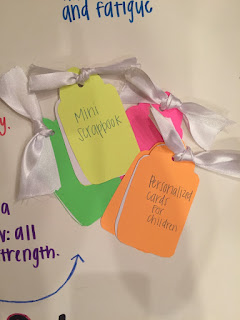
Finished product in multiple forms

Overall media project
Diagnosis: Amyotrophic Lateral Sclerosis (ALS)
About: 55 year old women that was diagnosed with ALS two years ago. She was recently admitted to acute care hospital with pneumonia and worsening mobility. She recently worked as a teachers aide in a public elementary school until last year. She was independent in ADL's but has been experiencing muscle weakness and fatigue and needs help opening food packages.
Interests: She enjoys watching tv/movies and playing cards with her family. She also enjoys scrapbooking and is currently working on a scrapbook that she will give to her daughter for her graduation present in a couple of months. She would also like to create a series of videos or cards to leave behind for her family.
Item: Index cards
Intervention: To address her interest of scrapbooking while working on fine motor skills and muscle strengthening I decided to have my client make "mini scrapbooks" or "personalized cards" out of index cards. Because she scrapbooks I knew she would have the materials at home to complete this intervention. My goals for her were to be able to trace a template from online (fine motor skills), draw and cut this template on multiple index cards with scissors (fine motor skills), hole punch them (muscle strengthening), and tie a ribbon through the hole (fine motor skills). In the end I would also like her to embrace her creativity through her scrapbooking and writing.
Below are pictures of the items I used in the intervention and what the final product could look like:

Items needed

Product before design/purpose

Finished product in multiple forms

Overall media project
Thursday, May 25, 2017
NN #4 - The Notebook
The Notebook - movie
The Notebook is a movie about a present day elderly couple, in which the wife, Allie, lives in a nursing home with dementia. Noah, her husband, reads her stories written from her personal journal in hopes to get her memory back. The movie is mainly focused on their previous stories that are written in the journal. But in the end the movie focuses on the fact that Allie suffers from dementia and cannot recall who her husband is, how they met, or what they have been through. At the end of the movie, Allie regains her memory for a brief moment and reconciles with her husband. She quickly forgets and panics sending the medical personnel in to sedate her. Because of the panic attack that Allie experienced, it gives Noah a heart attack landing him in the hospital as well. In the middle of the night Noah sneaks into Allie's room and crawls into bed with her. Allie regains her memory once again long enough to tell Noah that she may forget him again at any moment. They both fall asleep in the same hospital bed and pass away together through the night. (What a tear jerker!!) The reason I chose to write over this movie was because a) it is one of my favorite movies (I'm a sucker for sappy love stories) and b) now that I have learned about dementia it is easier to understand the background and reason for the story. From watching it the first 100 times I thought that there were some semi-unrealistic assumptions around dementia portrayed in the movie. For example, Allie regains her memory twice within one day. It is very rare for this to occur especially with people in late stage dementia. It is more likely for them to remember childhood memories and be stuck in that time rather than mid-life memories. And now knowing more about dementia, I realized that there are also some realistic symptoms of dementia shown in the movie. For example, Noah mentions his and Allie's name over and over again, and Allie seems to not know who Noah is or that he is her husband and doesn't even realize that her own name is Allie. Another example would be when she loses her memory as fast as she regained it and finds herself in Noah's arm while he's calling her sweetheart. She becomes very confused, angry, and defensive. It is very common for people with dementia to show aggressiveness towards the ones they love without even knowing it. Because this is such popular movie and is known for its love story I think it is important for people, especially us in the health profession, to pay attention to the underlying plot and what common people assume about a neurological disorder. Next time you watch this movie, or if you haven't ever I suggest that you take the time to, pay attention to the assumptions and realistic features of a movie. Especially one that is centered on a disease or disorder.
Wednesday, May 24, 2017
Caroline's case study - Dementia
This is the first case study presentation group that I have been apart of that included a personal story. Caroline's client, Ruby, was her biological grandmother who experienced dementia that was caused by Alzheimer's Disease. One thing I found interesting was that her grandmother was not actually diagnosed with Alzheimer's until 6 years AFTER her symptoms began. Her family, friends, and some doctors just assumed her forgetfulness was happening because of her age. Once she started forgetting who people were and started showing abnormal behavior towards them the doctors issued multiple tests to finally diagnose her. And at this point she was in the late stages of Alzheimer's. She eventually became very lethargic and stopped doing things she loved such as gardening and sewing. Because Caroline's grandmother passed away a few years ago, Caroline's intervention plan and goals for Ruby weren't personally given to her. But, with a little research from her mom she did find out that Ruby actually saw an occupational therapist when she was alive and one of her goals then was to work on self feeding. Caroline took this information and applied it to a intervention plan that would be fit for her today as if she was alive. I enjoyed hearing about Ruby and think Caroline would have met her grandmother's goals if she were her occupational therapist.
Monday, May 22, 2017
Audrey's Case Study: MD
Audrey took her case study topic and put a different prospective on it. Instead of having muscular dystrophy, Brandon Walker has congenital myopathy. Congenital myopathy has similar symptoms as muscular dystrophy (such as weakness in hands and feet and fatigue) except that in Brandon's case it is not progressive or leads to death. He was born with it and has lived with it his whole life. He is currently 39 years old but Audrey did her interventions as if he is 20 years old for OT purposes. His goals are to live by himself and learn how to drive. He wants to be fully independent by living by himself and since he is a country artist and performs different places all the time he wants to be able to drive himself around. Because he has been in a wheelchair his entire life as well, walking is something he doesn't know and does not want improved. He saw an OT when he was way younger but no further information was accessible about any other therapy. On that note, I think Audrey did an excellent job creating a fictional intervention out of a real life situation.
Wednesday, May 17, 2017
My Case Study - Trey Gray
Today I presented my case study over Huntington's Disease on Trey Gray, the drummer for country band Brooks and Dunn. I addressed the basics about Trey to my group members such as: he was diagnosed in 2003 at age 34, his mom and uncle both were diagnosed and died from HD, and his main priority was to drum as long as he can until the disease took over. I explained that little information was given about him on the internet past the year of 2008, for my assumption that he is in middle / late stages of HD and no longer wants his life centered around publicity. None of his interviews mentioned OT or PT, so based on what he said was important to him in some of his interviews is what I centered in on for intervention. And because it is a progressive disease, I focused on maintaining and managing skills rather than improvement. My group members seemed very interested in the topic because they asked a lot of questions pertaining to my client and to the disease in general.
Tuesday, May 16, 2017
LAST FOCP BLOG POST!!!
I had already wrote a blog post reflecting my learning from FOCP so read that one first :) So for this one I'll hit on our debriefing session today. I'm going to be completely honest, sometimes when I hear the word debrief I get a little anxious and irritated because I think in my head "oh he/she doesn't care for what I have to say" or "I have nothing to say at all". Today was different though. I appreciate that you take what we have to say to heart and actually use our suggestions to profess your course. I guess this is something I'm not used to from undergrad. I'm proud of my class for not tearing each other a part for the suggestions we made, instead we either backed each other up or we made other suggestions to improve the initial suggestion. Doing this before taking the FOCP eval will help me a lot because I've gathered my thoughts already! I've enjoyed our time together, even though its not over, and I hope to take with me everything that was learned in this course. Thank you!
Elvis has left the building
- Must touch on my era presentation that helped me loosen up around my classmates :)
Elvis has left the building
- Must touch on my era presentation that helped me loosen up around my classmates :)
Monday, May 15, 2017
NN #3 - How It Feels To Have A Stroke
Ted Talk - How It Feels To Have A Stroke
Jill Taylor decided to study the brain after her brother suffered from a brain disorder, schizophrenia. She became a neuroanatomist and one morning she realized she was having a massive stroke. And like any brain scientist would, she studied what her body was doing and remembered every bit of it and lived to tell her story on a Ted Talk. She said it was a normal morning but instead woke up with a pounding headache behind her left eye. She ignored the headache and got on her cardioglider (workout machine) to start her normal daily routine. While on the machine she began noticing something weird about her body. She said as if her state of consciousness has shifted away from her perception of reality. Instead of looking out away from her body, she was watching herself from an outside perspective. As her headache worsened, she got off the machine and began to walk to her bathroom where she says that she could no longer define the boundaries of her body because the atoms and molecules of her arm, blended with the atoms and molecules of the wall. She describes her left hemisphere of her brain being shut off by a tv remote, it became totally silent. As it turned off she says she entered "lala land" where she just felt one with energy and kept expanded. Then like another switch, the left hemisphere started working again reminding her that there was a problem. Another switch, another entrance to the external world. Another switch, another time, it switched back on and she quickly realized that she needed to seek help. Suddenly her right arm went limp, paralyzed to her side and she knew then she was having a stroke. Throughout the video she describes how cool it felt and was wondering how many times do brain scientists get to study their own brain from the inside out.
Jill goes on to tell how she sought help and brings humor into every bit of it. At one point in the ambulance she describes her spirit leaving her body, almost surrendering to what was happening in her brain. And she thought "this is it". The doctors were either going to save her or she was going to die. When she woke later that afternoon, she was shocked to still be alive. She describes that the noises were so loud that she couldn't depict a voice out in the room, and that the light was so bright that it burned her eyes. She was still enormous and out of her body but realized again that she was alive and that she needed to take advantage of it. The hemorrhage was the size of a golf-ball in the left hemisphere of her brain that was pushing on her language center.
She took her tragic incident and turned it into a "gift". She thought what if people could use this and take a step to the right of their left hemisphere? This motivated her to recover, which took 8 years. She now believes that we have the choice of being the one individual portrayed from our left hemisphere or the "me's inside of me" portrayed from our right hemisphere. And if we all chose the right hemisphere, we would live in a more peaceful world. She ultimately connected her stroke to how our brain defines us and connects us to different worlds. This was honestly one of the most interesting Ted Talks I have watched. It made me put a new prospective on encountering a neurological disorder and the potential research that could be continued because of remembrance. I highly recommend watching it and possibly showing it to future classes when stroke is the center of topic.
Reference:
Psych: Documentary Films. (August 19, 2012). Ted Talks: How It Feels To Have A Stroke. Retrieved from: https://psychdocumentaryfilms.wordpress.com/2012/08/19/ted-talks-how-it-feels-to-have-a-stroke/
Lauren McGee's Case Study - MG
Lauren did a wonderful job digging down deep to find a personal story over Myasthenia Gravis. She found a testimonial on the MG website, found a story she admired, and pursued the girl on Facebook to get on a more personal level. Lauren says the girl (Amanda Jones) was very humble but glad someone was reaching out to her to talk about MG since it isn't widely known about. Amanda hasn't tried occupational therapy but Lauren gave good examples of adaptive technology that could be used for her situation. She has a passion for photography but her MG happens sporadically so she has to cancel on people a lot. Lauren suggested taking pictures of landscapes and nature so she can continue her passion without having to cancel. She also suggested for the use of a tripod or a photography assistant to help her when she is easily fatigued. I thought the tripod was an interesting idea because I had never thought of it as "adaptive equipment", but in the case of Amanda it most definitely could. Overall Lauren did an tremendous job.
Sunday, May 14, 2017
FOCP Reflection
Foundations of Occupation Centered Practice has introduced me to the concepts and skills needed to further my career as an occupational therapist. It has helped me learn the background of the profession and who is responsible for the popularity and greatness of what we know as occupational therapy. Compared to other courses, I feel as if this one was greatly beneficial to my knowledge on the profession as a whole and what I need to do as a practitioner to keep my knowledge at its peak. Because both historical and present perspectives were directed toward us, we now know how far the profession has come over the last 100 years and how quickly things can change over time. This lets us know as future practitioners that we are responsible for the future of OT, we are the caretakers, and we can make huge differences over the next 100 years. One of my biggest goals coming into graduate school was to work on my communication skills and behaviors with clients. They have never been bad but I wanted to "perfect" them and make them more efficient especially in a clinical situation. FOCP has helped established a base and some foundation to my so-called "communication house". Because of this course I know how to effectively deliver an elevator-speech about the profession along with knowing how to advocate for and demonstrate what occupational therapy is and its values. I now know the importance of this class and what its relationship to our other curriculum is. FOCP was a well administered and a beneficial class to start my first term off with as a occupational therapy student.
Professional Development
Learning about professional development throughout school and our later careers is a key factor in learning about how an occupational therapist should act. As an OT practitioner we are committed to being life-long learners. We do this so we can never stop growing, so we can keep an open-mind about things, and so we can keep up with the latest trends in technology and research. Along with being a life-long learner we also should continue competence. Continuing competence is our ability to do something successfully and efficiently while ensuring the quality of service to our clients, this also protects our clients. Not only is professional development required to keep our license but neglecting this part of our job can potentially harm a client and ourself as the practitioner. Planning for and seeking out further opportunities and experiences to add to our knowledge and skills is the greatest accomplishment we can do throughout our career.
Therapeutic Use of Self
Since starting school, we have heard about "therapeutic use of self" and "therapeutic relationship" and have used the terms interchangeably but haven't gotten the full meaning behind them. Now that are first term is coming to an end we have finally found the meanings and now know that we cannot use these terms interchangeably ;). Therapeutic relationship is ideally the interaction between an occupational therapist practitioner and the client. Therapeutic use of self is when the OT practitioner themselves identifies the goals and objectives of the client, develops an intervention plan, and uses their interactions with the client to achieve the client's desired goals. Essentially, therapeutic use of self is a key component of a therapeutic relationship, along with other qualities such as active listening, empathy, humor, verbal and non-verbal communication, and empowerment.
Wednesday, May 10, 2017
Lauren Laborde's Case Study - ALS
Lauren's case study ironically was focused on Lou Gehrig. This was the person that ALS was informally named after ("Lou Gehrig's disease"). In addition to her research over Lou and his disease, she also put in extra effort to find out why it was named after him. The only conclusion she could up with is that he was the first "famous person / athlete" to be diagnosed with this condition in the United States. Outside of the U.S. ALS is not known as Lou Gehrig's disease. Because of the time of his death, Lauren did an excellent job on portraying the differences in occupational therapy then (1940) and now (2017). She mentioned that occupational therapy was still relatively new when he was diagnosed and might be a part of the reason he only lived for three years after diagnoses. Adaptive equipment was limited and couldn't put much affect of quality of life. Lauren expressed intervention planning around optimizing strength and ROM, maintaining function in ADL and iADL, decreasing fatigue, and managing pain and energy. Overall, I think this was an excellent choice considering Lou's condition made him degenerate.
Monday, May 8, 2017
Making a universal cuff
Today in class we got to get hands-on once again (these are my favorite days) and make a universal cuff. After a little tweeking and do-it-agains, all different types of cuffs were made. Even though we had a sheet full of directions, I like that we were able to be free-spirited with our cuffs. Because they are universal, each one shouldn't and won't be the same when making and providing them to clients in the future. I like this activity particularly because it involved a simple "tools needed" list. We didn't have to get fancy with a sewing machine but instead we used everyday household items such as duct-tape, scissors, velcro, and elastic. This is an easy and cheap way (low tech) to introduce assistive technology into a client's life. Like my activity analysis, I added the directional worksheet to my professional development portfolio for future use.
Subscribe to:
Posts (Atom)